

The best way I’ve heard to describe creating sales tax returns is as a time vampire. It wastes time. It seems simple at first, but it ends up taking much longer than you anticipated, and it happens again every month or three months.
You’re not alone either: Every reporting period, merchants claim to spend hours or days piecing together various statistics, trying to understand why numbers vary, making manual adjustments, and playing the frustrating game of “What cities belong to which counties?” It’s understandable why so many business owners throw up their hands and pay third parties hundreds of dollars each month to format their own data.
Table of Content
- What exactly is the United States Sales Tax Report?
- What’s Important About Sales Tax Compliance?
- What advantages does the new report offer?
- How does the US sales tax report function?
- Benefits of using shopify tax for sales tax reporting
- Tax Tools to Improve Compliance
- The challenges of Reporting Sales Tax
- Conclusion
What exactly is the United States Sales Tax Report?
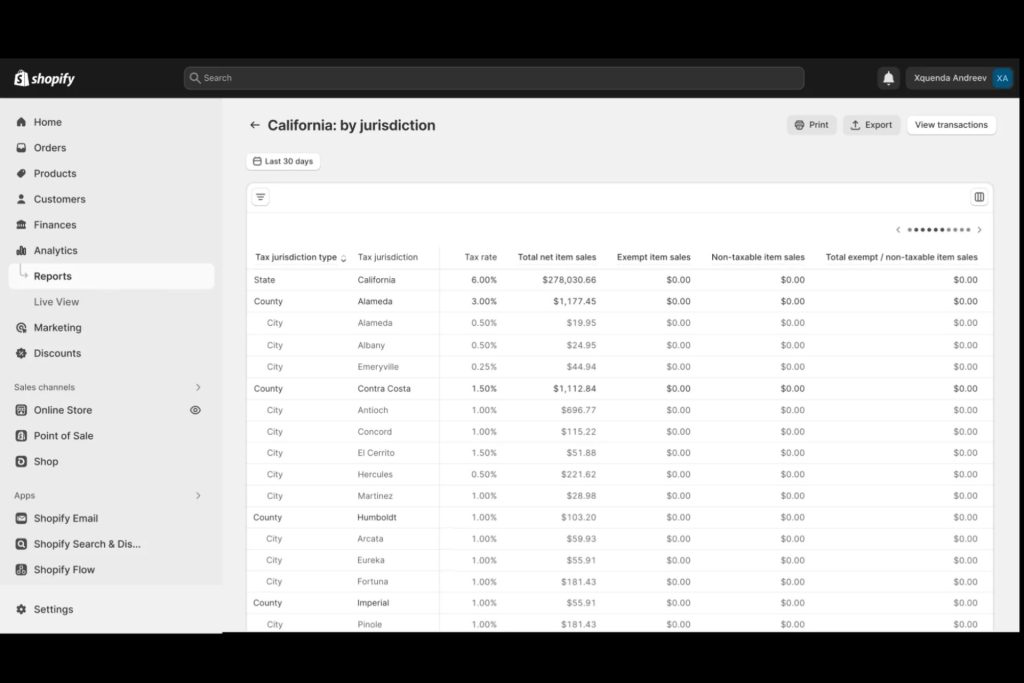
All the information you need to get ready to file your sales tax is now almost instantly available. The exact reporting code is provided, along with the net sales and taxable sales breakdowns by state, county, and local level jurisdictions in this new report.
To demonstrate how each order contributed to the totals, transaction details are available. What once could have taken days or hours can now be done in a fraction of the time.
What’s Important About Sales Tax Compliance?
Every online business must take seriously their obligation to comply with sales tax laws. Neglecting to abide with sales tax laws can have serious repercussions, including high fines, penalties, or even legal action. Non-compliance can also harm a company’s reputation and undermine customer trust. Having strong procedures in place to ensure accurate and timely tax reporting is essential for merchants given the growing attention tax authorities are giving to e-commerce.
For companies of all sizes, paying sales taxes is essential, whether they sell online or through physical locations. Sales tax compliance is crucial for the following reasons:
- Legal liability: Businesses that disregard sales tax regulations risk sanctions, fines, and even criminal prosecution. In certain instances, failing to abide by sales tax requirements resulted in firms being forced to close.
- Financial hazard: Businesses who don’t gather and submit sales tax may be held financially responsible. This is due to the fact that, even though they did not collect the sales tax from their clients, they are still obligated to pay it to the government.
- A reputational hit: Businesses’ reputations may be damaged if they are discovered to be in violation of sales tax legislation. This may result in disgruntled customers, lower sales, and trouble luring new investors.
- Increased fees for compliance: Businesses who don’t abide by sales tax legislation may eventually be required to pay greater compliance expenses. This is due to the possibility that they will need to hire a tax expert to assist them in becoming compliant or that they will be required to pay penalties and interest on the taxes they failed to collect.
What advantages does the new report offer?
access to the information you need to file quickly and easily
A single report with data split down by state, county, city, and time period is accessible with sales and tax statistics. Where feasible, jurisdiction codes are offered to help you choose the correct amounts for each line item in your filing.
More thorough reports that are tailored to your needs
You can alter the report to suit your needs. Filter by location or timeframe, or hide columns. Obtain the view you desire. Remember how you would only receive full credit in grammar school if your answer was correct and you submitted your work? We concur. Because of this, complete transaction data is offered for reference and auditing needs.
For those already using Shopify Tax
Enhanced reporting is included and available at no extra cost. Additionally, as it is already integrated with your admin, you won’t need to deal with different platforms, passwords, or support personnel. For all of your sales tax requirements, Shopify is your one-stop shop.
How does the US sales tax report function?
Go to your Reports in your Shopify admin and look for US sales tax there. This report is composed primarily of three parts:
- 1. When you first open the report, the main view is the Country view. It breaks down the net sales and taxes taken in by each state.
- 2. You can access the Jurisdiction view by touching on a state. A breakdown of net sales and taxes collected for a particular state, as well as county, city, and special taxes (if applicable), are provided in the Jurisdiction view.
- 3. To get a full analysis of each transaction where tax was collected, select get Transactions from either report.
The reports can be further customised in a number of ways:
- By tapping the button just above the table that defaults to Month to Date, time periods can be changed (custom date ranges, quarters, and years will soon be available as possibilities).
- By tapping on the column icon in the top right corner of the table, columns can be added or removed.
- By touching the filter symbol in the table’s upper left corner, filters can be applied.
By selecting Export in the top right corner of the page, all reports can be exported.
Benefits of using shopify tax for sales tax reporting
The benefits of using Shopify Tax for sales tax reporting include the following:
- Calculations of the current and accurate sales taxes: Your sales tax computations are precise and current because to Shopify Tax’s utilisation of real-time data from state and municipal agencies.
- Reports that are simple to use: Shopify Tax offers reports that are simple to use and provide you a clear picture of the sales tax you have collected by state, county, and city.
- Support for compliance: Shopify Tax offers compliance support to assist you in keeping abreast of the most recent changes to sales tax laws and regulations.

Tax Tools to Improve Compliance
Shopify now offers a set of tax tools in addition to the upgraded Tax Reporting system to further increase compliance and make tax management for merchants simpler.
1. Avalara AvaTax Integration:
Shopify and Avalara AvaTax, a top provider of tax compliance software, have teamed up to provide users a thorough tax automation tool. Businesses may use AvaTax to automate tax computations, produce real-time tax rates, and even submit tax returns right from the platform.
Another effective tax management application, TaxJar, has a smooth integration with Shopify. With features like precise tax computations, thorough reporting, and auto-filing options, it makes it simple for businesses to maintain compliance.
The challenges of Reporting Sales Tax
It is important to not undervalue the difficulties involved in sales tax reporting. The following difficulties are frequent for online businesses:
- Nexus Determination: It might be difficult to determine where a company has sales tax nexus (a major presence). Nexus is frequently determined by elements like geographic location, economic activity, and sales volume in a given state or region.
- Tax Rate Variations: Due to local or county taxes, sales tax rates vary from state to state and sometimes even within a single state. It might take a lot of effort and be difficult to apply these rates consistently to transactions.
- Product Taxability: In some areas, certain products may not be subject to sales tax, while other products may be subject to higher tax rates. Accurately managing product taxability necessitates close attention to detail.
Conclusion
The ability to keep up with sales taxes is essential for operating an online business. A huge step forward in assisting merchants in navigating the complexity of tax legislation has been made by Shopify with the introduction of improved sales tax reporting tools. The accurate and prompt tax collection, the reduction of errors, and the improvement of overall compliance can all be achieved by merchants using automated nexus determination, real-time tax rate calculation, and seamless reporting. Online merchants may concentrate on expanding their business while staying in compliance with constantly altering tax rules by utilising this new function, which will eventually contribute to their long-term success in the cutthroat e-commerce environment.
Join us as you begin your Shopify journey
We are e-commerce specialists and Shopify Partners. Get in touch with us if you need assistance with Shopify, need a whole website built, or have any other general questions.