

It goes without saying that making a profit is necessary for a successful firm to function. Profits, however, are not all made equal.
For instance, a little profit will enough if your objective is to earn enough money to pay your running costs and maintain yourself as a business owner. However, if you want to grow your company, hire more people, and spend money on R&D for your next line of products, you’ll need profit margins that can support the overall cost of those goals over time.
Learn the concept of profit margin, the many types of profit margin, and how average profit margins vary across various firms and industries in this guide.
Table of Content
- What Is a Margin of Profit?
- Types of profit margin with formula,s
- Calculating Profit Margin: Step by step
- Shopify profit margin strategies
- Significance of profit margin
- Conclusion
What Is a Margin of Profit?
A financial statistic called profit margin shows what proportion of revenue a company keeps after paying all costs. In plainer terms, it gauges how effectively a business turns sales into profits. It’s an analytical indicator that enables organisations and investors to evaluate the price policy, cost structure, and general financial success of the company.
The profitability of a company, product, or service is determined by its profit margin. Profit margin is expressed as a percentage as opposed to a monetary value. The greater the figure, the greater the profit the company realises in relation to its expenses.
Businesses with limited profit margins
Below-average profit margin companies and products include:
- Restaurants: Due to the numerous expenses they must manage, such as labour, ingredients, overhead, and rent, restaurants typically have smaller profit margins.
- Transportation: The low profit margins in the transportation industry are a result of the high cost of infrastructure, maintenance, and fuel or power.
- Agriculture products: Agriculture has a low profit margin due to its large inventory levels, strong demand for resources, and shortages of land and storage capacity.
A corporation may still be profitable even when its profit margin is lower. Contrarily, the majority of these enterprises make up for reduced profit margins by selling more clients, goods, or materials.
Businesses that have large profit margins
Some companies and products with greater profit margins are:
- Upscale items: High profit margins are typically seen in businesses that produce luxury and specialist goods, such as clothing, jewellery, watches, cosmetics, and sports vehicles. These products’ manufacturers can afford to mark up their retail prices greatly because of their reputation for exclusivity, luxury, and status. This allows them to make a sizable profit despite seeing a decline in sales.
- Video games and software: Even though game and software creators may spend years refining their creations, they frequently make a sizable profit on each copy or licence that is subsequently sold.
- Medical supplies and pharmaceuticals: Similar to this, corporations that manufacture medical devices and drugs invest billions of dollars in research and development before realising a major profit from the sale of patent-protected gadgets and treatments.

Types of profit margin with formula,s
There are various profit margin types, and each one offers a unique viewpoint on how profitable a business is? Retailers and other small enterprises frequently consider three different types of profit margins:
1. Gross profit margin definition
Use of gross profit margin
Formula
2. Operating profit margin definition
Use of operating profit margin
Formula
3. Net profit margin definition.
Use of net profit margin
Formula
Calculating profit margin: Step by step
You need precise financial information from an income statement of a corporation to calculate profit margin. Here is a detailed instruction:
Choose the Type of Profit Margin:
Based on the depth of knowledge you require, decide whether you want to calculate gross, operational, or net profit margin.
Obtain Financial Data:
Obtain the income statement of the business, which lists the company’s sales, costs of items sold, operational expenses, interest costs, and taxes paid.
Determine the Relevant Profit:
Determine the appropriate profit based on the type of profit margin. For instance:
Gross Profit= Total Revenue – COGS
Operating Profit = Gross profit – Operating Expenses
Net Profit= Operating profit – interest and taxes
Calculate the Margin:
To obtain the percentage value, divide the computed profit by the total revenue and multiply by 100.
Interpretation:
A higher profit margin denotes improved cost management and revenue generation efficiency. A reduced margin, on the other hand, can point to the necessity of streamlining processes, adjusting prices, or cutting costs.
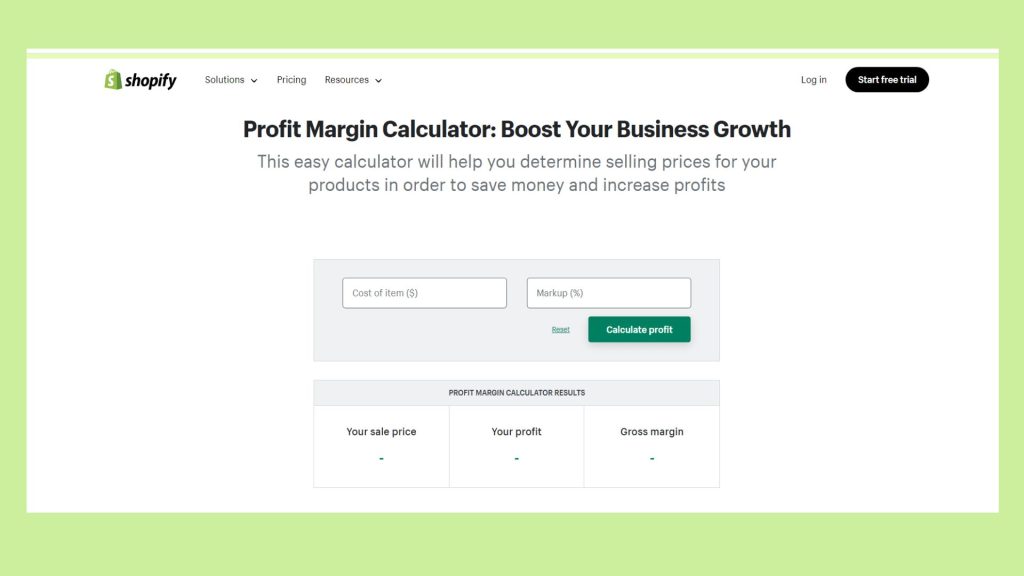
Shopify profit margin strategies
For Shopify business owners, increasing profit margins requires a calculated strategy:
- Pricing Strategy: When determining product prices, understanding your profit margins is essential. Along with your costs, take into account market demand and rivals’ prices.
- Cost management: Lower production costs by locating materials effectively and looking into supplier bulk discounts.
- Upselling and cross-selling: Promote related or upgraded products to customers during their shopping experience to raise the average order value and maybe increase margins. This is known as upselling and cross-selling.
- Shipping and fulfilment: Fulfilment and shipping expenses can be reduced by effective logistics management, which boosts profit margins.
- Marketing efficiency: Ensure that your profits are not being eroded by high customer acquisition costs by concentrating on the marketing channels that produce the best ROI.
- Continuous Analysis: Examine your financial records frequently and change your tactics in response to evolving conditions.
Significance of profit margin
For a variety of stakeholders, profit margin is a powerful tool:
- Business owners and managers: Tracking profit margins enables companies to assess their financial plans, establish fair prices, and locate cost-cutting opportunities.
- Investors: Investors evaluate a company’s growth potential and return on investment using its profit margin. A company with consistently high margins is likely to be well-run and financially secure.
- Competitive analysis: Comparing profit margins within a certain industry can help businesses determine how competitive they are. If your margin falls short of rivals, you may want to reconsider your strategy.
- Strategies: Profit margins have an impact on strategic choices including growth, product development, and investment. In order to take measured risks, you need to have a healthy margin.
Conclusion
Profit margin is a crucial indicator that sheds light on a business’s financial performance. You may learn a lot about a company’s profitability, effectiveness, and potential for growth by understanding the many sorts of profit margins and learning how to calculate them correctly. Profit margin is a crucial instrument that enables educated decision-making in the dynamic world of business, whether you’re managing a company or thinking about investments.
Join us as you begin your Shopify journey
We are e-commerce specialists and Shopify Partners. Get in touch with us if you need assistance with Shopify, need a whole website built, or have any other general questions.